
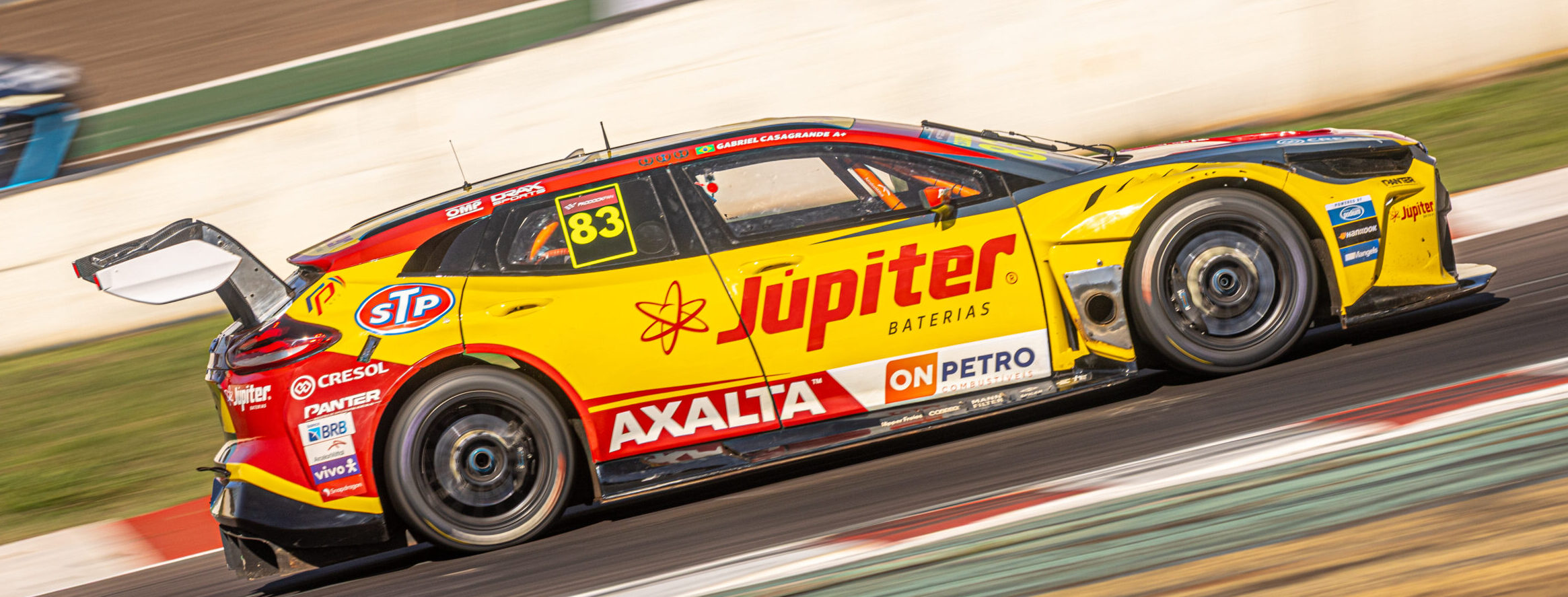
Telemetry and data acquisition have been part of motorsport for a few decades now, and starting in 2025, Stock Car Pro Series officially began featuring this technology onboard all cars of the new generation (SNG). Understanding how Stock Car telemetry works is essential to grasping real-time data transmission, its integration with the car’s logger, and its practical applications in race engineering.
Put simply, telemetry is the real-time transmission of data from the car to the engineering team. But have you ever stopped to think about how that communication actually happens? In this article, we’ll explain how data transmission works, how it differs from traditional data acquisition, and why this technology is so relevant in motorsport.
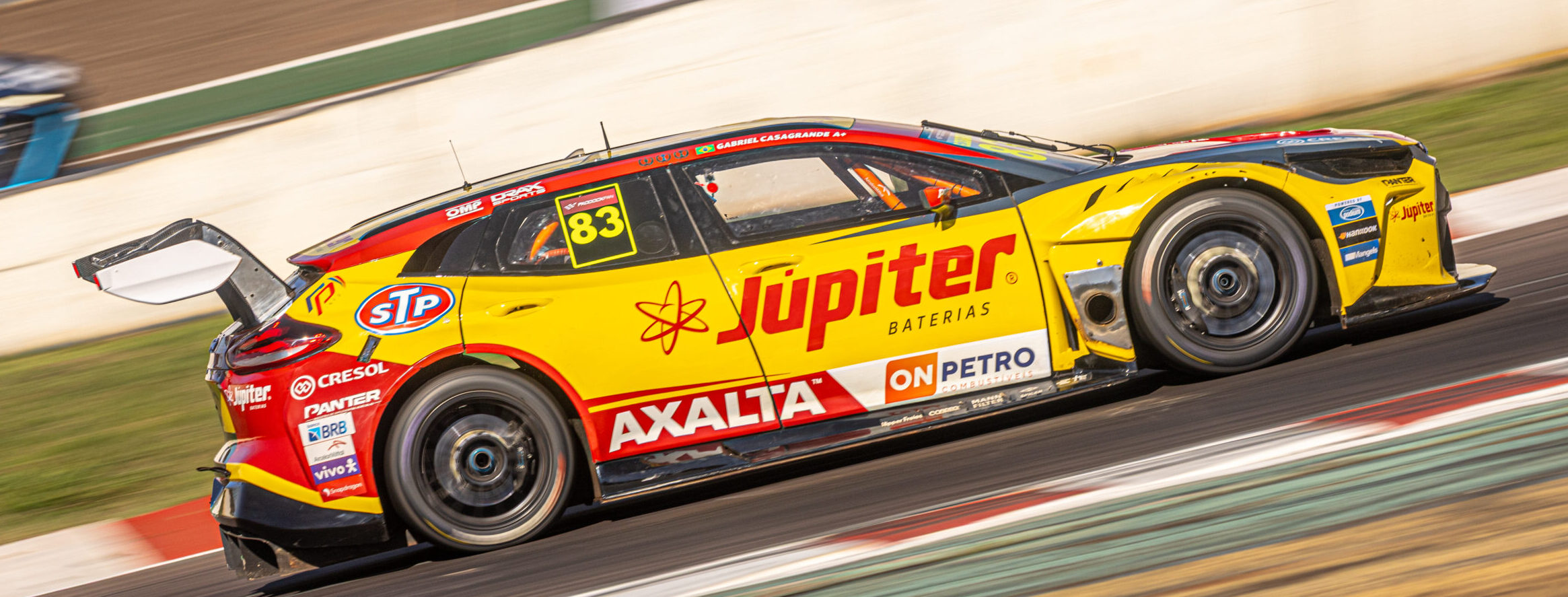
Stock Car SNG car equipped with a telemetry and data acquisition system.
Data transmission: from the car to the team
A modern race car can have dozens of sensors spread across different systems: tire pressure and temperature, pedal position, engine RPM, steering wheel position, oil pressure, among others. All of these signals are transmitted over the CAN network, which acts as the vehicle’s communication “backbone.”
This data reaches the data logger, which records everything to internal memory for later analysis. Up to this point, we’re only talking about data acquisition — that is, collection and storage.
Telemetry is a step beyond that: it captures the signals from the CAN network and sends them outside the car in real time. Historically, this started with radio transmission, where engineers received data packets through antennas at the track. This process had limited range and was prone to interference.
As mobile technology evolved, transmission moved to 4G and 5G, bringing several advantages:
- Greater coverage and stability
- The ability to send data to external servers
- The ability for engineers to work remotely, following cars at different tracks
One piece of equipment commonly used in this process is the Bosch LTE-65, which functions as a telemetry modem. It receives signals from the logger, uses a cellular chip, and continuously sends data to a secure internet address.
In practice, this allows an engineer, even miles away from the track, to monitor critical car parameters in real time, helping anticipate problems or make strategic decisions.
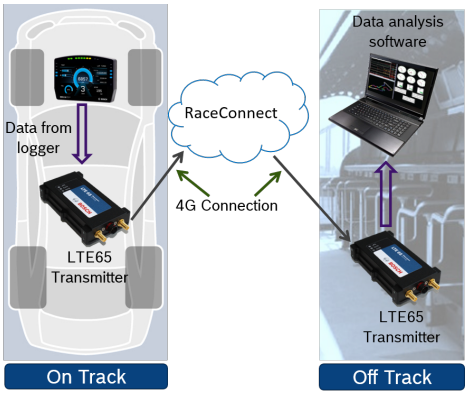
Diagram of data transmission from sensors to the team. Source: Bosch Motorsport
Data security and confidentiality
But if data travels across the whole track, couldn’t one team intercept another team’s information?
The answer is no. Packets can be encrypted, which ensures that even if another team “sees” the transmission, it won’t be able to decode or access its content.
There’s also an important detail specific to Stock Car:
Data doesn’t go directly from the car to the team.
It first passes through the category’s organization, which then relays it to the teams.
This process ensures technical fairness and transparency, allowing the organization to detect failures, abnormal performance, or even possible tampering attempts.
Telemetry vs. data acquisition
It’s common to confuse telemetry with acquisition, but they’re complementary processes.
Data acquisition is the complete recording of all sensor information, at a high sampling rate, stored on the car’s logger.
Telemetry is the real-time transmission of part of that data to the engineering team.
The main difference lies in the amount of information and the sampling rate. The logger can record thousands of data points per second across all available sensors. Telemetry, on the other hand, is limited by network bandwidth — it’s not possible to transmit everything at the same frequency without risking congestion or packet loss.
That’s why engineers need to choose which channels are most important to monitor live, prioritizing critical variables such as:
- Speed
- RPM
- Oil pressure and temperature
- Fuel pressure
- Sensor fault alerts
To better understand how to analyze each channel in practice, check out our article “How to interpret a telemetry channel.”
Another relevant point is temporal resolution. While acquisition records complete data for detailed analysis in the garage, telemetry provides a “summarized” version, sufficient for monitoring the car’s health and supporting strategy during the race.
This balance is essential: telemetry helps with immediate response, while acquisition allows for deep, comparative analysis after the event.
In short: telemetry saves races, but it’s the logger that builds long-term knowledge.
The difference between UDP and TCP protocols
To understand how data reaches the engineering team, it’s important to know the two protocols that carry information across the network: UDP and TCP. Both are part of the internet’s transport layer, but they work in very different ways.
UDP (User Datagram Protocol)
UDP is known as a simple, lightweight, and fast protocol. It sends data packets without checking whether they all arrived or arrived in the correct order. This “lack of guarantees” might sound like a problem in other contexts, but in motorsport it’s a major advantage:
Packets leave the car and arrive nearly in real time, with very low latency.
Even if a packet is lost, the analysis isn’t compromised, since the following data arrives right after and the software interpolates the values.
It’s ideal for situations where transmission speed matters more than absolute data integrity.
That’s why categories like Stock Car prioritize using UDP during sessions. It ensures engineers receive vital data — such as temperature, pressure, speed, and fault alerts — almost instantly.
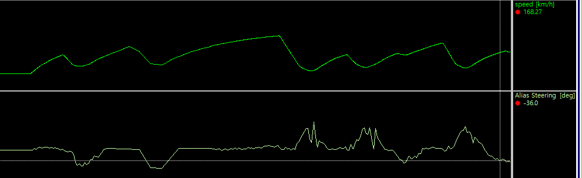
Data packets carrying steering wheel position information were lost in turn two, so the software interpolated the received data.
TCP (Transmission Control Protocol)
TCP, on the other hand, is the protocol built for reliability. Every packet sent must be acknowledged by the receiver. If a packet is lost, the system retransmits it until it can guarantee everything was delivered in the correct order. This means:
No information is lost.
The record is complete and ordered.
It’s the natural choice for transmissions that can’t afford failures, such as sending post-race reports or sensitive data to the organization.
The downside is cost: higher latency, more processing load, and less agility. During a race, that delay can be critical. Imagine an engineer receiving an oil pressure fault alert with a 3-second delay — the car could break down before the team even has a chance to react.
Conclusion
The introduction of telemetry in Stock Car significantly expands the possibilities for real-time analysis, enabling faster diagnostics, strategic support, and greater technical control across the category.
That said, it’s important to keep in mind:
Real-time transmission doesn’t replace the full data acquired by the logger.
Bandwidth limitations and the choice of protocol (UDP or TCP) directly affect the quality and reliability of the information.
Mastering these differences is essential for engineers and teams looking to get the most out of telemetry — complementing the detailed analysis that continues to happen in the garage.
And if you want to master telemetry and data acquisition, enrollment for the second class of ECAD opens on 10/15. Fill out the interest form to receive updates.


